How Drone Crop Treatment Is Changing UK Farmland Management
I have walked enough muddy fields in the UK to know that the old ways of spreading fertiliser and spraying crops are hard on the land and harder on the people doing the work. For years, the standard approach meant a tractor, a heavy sprayer, and a lot of diesel. But something has shifted. Over the past few seasons, I have watched farmers and agronomists quietly adopt a different tool: the agricultural drone. What started as a novelty for aerial photos has become a serious piece of farm equipment. The phrase "drone crop treatment" now appears in conversations about precision agriculture, and it deserves that place.
What Drone Crop Treatment Actually Means on the Ground
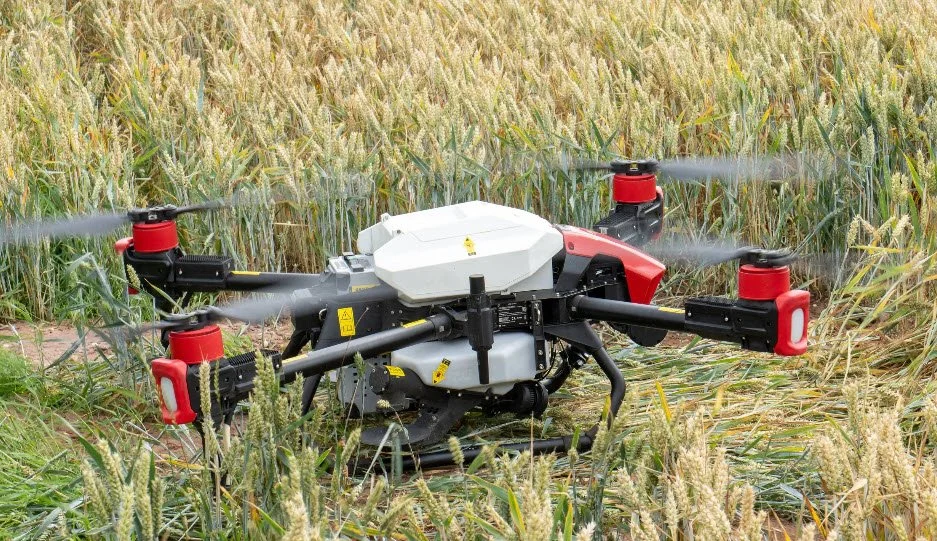
When I first heard the term, I assumed it meant something like a helicopter with a nozzle, just smaller. That is not quite right. Drone crop treatment covers a range of tasks: drone spraying of pesticides, herbicides, and fungicides; seed drilling into hard-to-reach areas; top dressing of fertiliser; and even variable rate application where the drone adjusts output as it flies. The difference from ground rigs is not just the absence of wheel ruts. It is the ability to treat crops when the ground is too wet to support a tractor, or when the crop is too tall to drive through without damage.
I remember a case last spring on heavy clay land in Herefordshire. The farmer needed to apply a fungicide to winter wheat, but the field had not dried out enough for a tractor. The spray window was closing. He called in a drone operator who flew a DJI Agras over the crop in less than three hours, covering the whole field with no compaction and no lost days. That is not a future scenario. That is already happening.
The Practical Advantages Over Ground Rigs
It is easy to list reasons why a farmer might choose drone spraying over a tractor or a trailed sprayer, but the real judgment comes from understanding trade-offs. Here are the main ones I see after talking to operators and growers across the country:
- No soil compaction. A tractor weighing several tonnes compacts the soil, especially in spring and autumn. A drone puts no weight on the ground at all.
- Access to steep or wet terrain. UK farmland includes plenty of slopes, headlands, and wet patches that a ground rig cannot reach without risk.
- Precision placement. Variable rate application from the air means you apply more product where the crop needs it and less where it does not. That saves money and reduces environmental load.
- Speed of deployment. A drone can be launched within minutes. There is no need to wait for the ground to dry or for a tractor to be free.
None of this means ground rigs are obsolete. For large, flat fields with good drainage, a tractor-mounted sprayer is still faster per hectare. But the drone fills a gap that ground equipment cannot reach.
How Aerial Application Changes Crop Protection Decisions
Crop protection is one of the most carefully timed operations on a farm. Apply a pesticide or fungicide too early and you waste the product. Apply it too late and the pest or disease has already done its damage. With drone spraying, you can treat a field the day after a scout flight identifies the problem. I have seen agronomists use crop scouting data from drones to map disease hotspots, then feed that geospatial data into the sprayer's flight plan. The result is a targeted application that uses less chemical and gives better control.
One agronomist I work with told me that before drones, he would sometimes delay a treatment because the ground was too soft or the crop too lodged to drive through. Now he can treat that same field from the air within hours. The phrase "drone crop treatment" in that context is not just a label. It is a description of a workflow that was impossible five years ago.
Fertiliser and Seed: Beyond Just Spraying
Most people think of spraying when they hear drone crop treatment, but the same platform can do top dressing of fertiliser and even seed drilling. In the UK, there is growing interest in using drones for establishing cover crops after the main harvest. The window between harvest and winter is short, and the ground is often too wet for a drill. A drone can broadcast seed over the stubble quickly, getting the cover crop established before the weather turns.
Variable rate application of fertiliser is another area where drones excel. Instead of applying a blanket rate across the whole field, the operator loads yield maps and field boundary data into the flight controller. The drone adjusts the output in real time as it passes over areas that historically yield less or more. This is precision agriculture in its most practical form. The fertiliser goes where it is needed, not where it is wasted.
Regulation and Practical Reality in the UK
Flying a drone for crop treatment in the UK is not something you do without a licence. The Civil Aviation Authority requires operators to hold a valid permission for commercial operations, and the drone itself must be insured and registered. For a DJI Agras or similar agricultural drone, the operator also needs to demonstrate competence in flying beyond visual line of sight if the field is large enough. That adds cost and complexity, but it also means the operators who do this work are serious about safety.
I have seen some farmers try to do it themselves with a consumer drone and a jury-rigged sprayer. It does not work well. The flight time is too short, the payload too small, and the risk of drift too high. Good results come from a dedicated agricultural drone with proper nozzles, flow control, and flight planning software. The cost of entry is high enough that most UK growers contract the work to a specialist provider rather than buying their own fleet.
Where the Technology Falls Short
It would be dishonest to write only about the benefits. Drone crop treatment has real limitations. Battery life is the obvious one. A typical agricultural drone can fly for ten to twenty minutes under load, then needs a battery swap and a recharge. That limits the area it can cover in a day. For a large arable farm with hundreds of hectares, a single drone cannot replace a tractor yet. The second limitation is weather. Drones are grounded in strong wind, heavy rain, or low cloud. In the UK, that can mean several lost days in a row.
There is also the question of drift. Aerial application is more susceptible to wind than a ground rig because the spray is released higher above the canopy. Operators have to use drift-reducing nozzles and pay close attention to wind speed and direction. The Civil Aviation Authority guidelines are strict on this, and for good reason. A neighbour's organic field or a watercourse downwind is not something you want to contaminate.
What the Next Season Might Bring
I expect to see more integration between drones and other farm data systems. The same geospatial data that guides a combine harvester can guide a drone. Yield maps, soil maps, and field boundary files already exist on most farms. Linking them to the drone's flight controller for variable rate application is a step that many are already taking. The third use of the phrase "drone crop treatment" in this article comes from that direction: as the data pipelines improve, drone crop treatment will become another routine option in the farm management toolbox, alongside ground rigs, helicopters, and manual spot spraying.
The practical outcome for UK farmland is a more flexible approach to crop protection, fertiliser, and seed establishment. Not a replacement for everything, but a genuine addition to what is possible. When the ground is too wet, the crop too tall, or the slope too steep, there is now an alternative that works. That is not hype. That is what I see happening in fields up and down the country.